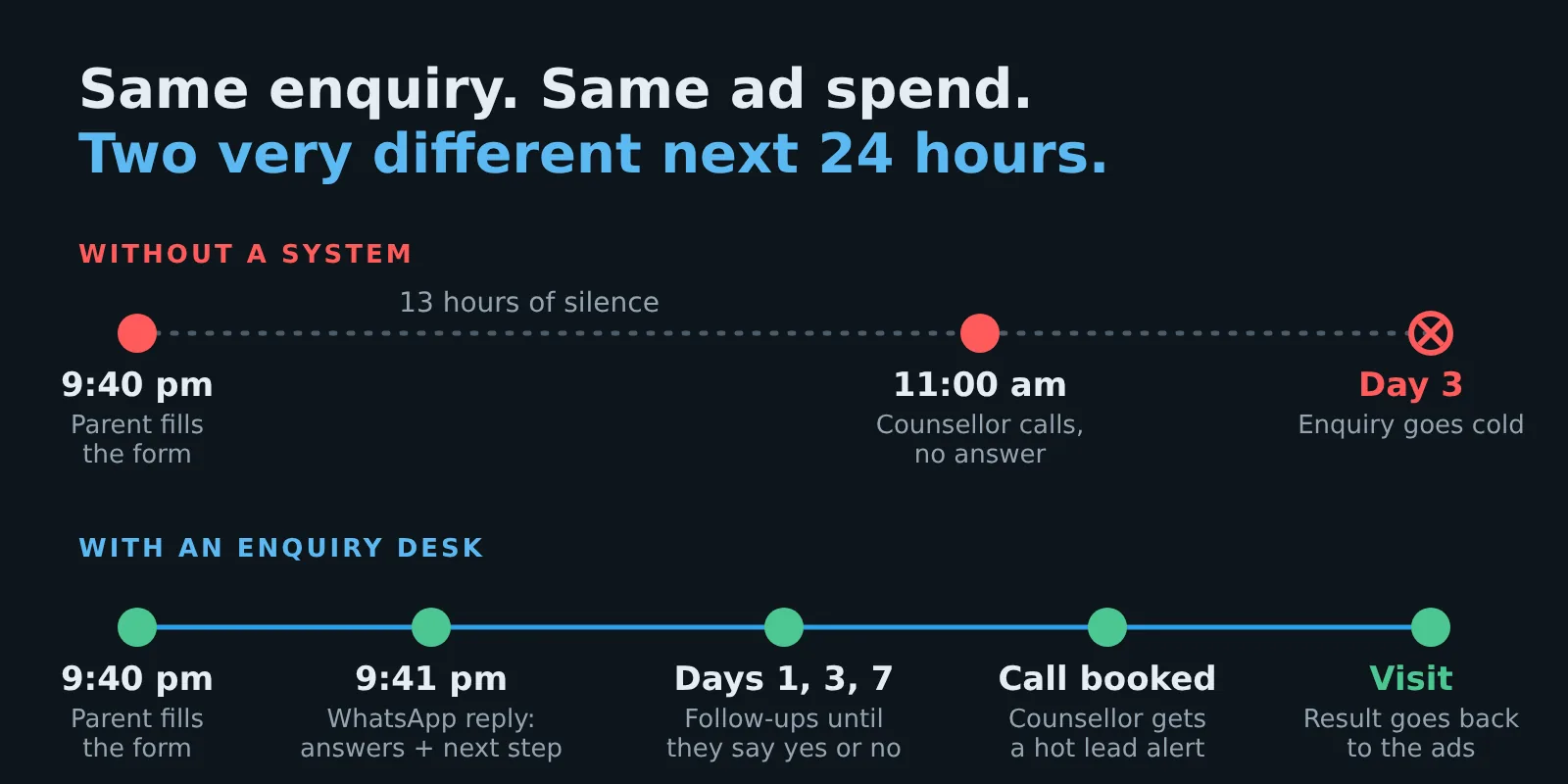
Colleges lose most admission enquiries after the ad click, not at the ad. The usual causes are a first reply that takes hours, a follow-up that stops after one or two tries, enquiries spread over three places and nobody owning them. The fix is a reply within minutes, a short follow-up ladder that stops on a no, one owner per enquiry, and sending admission results back to the ad platforms.
- An enquiry is paid for twice: once to the ad platform, and again in the counsellor time spent chasing it. Both are wasted if the first reply is late.
- A study of 2,241 US companies found only 37% replied to a web enquiry within an hour. 23% never replied at all. These are not colleges, but they show how normal slow replies are.
- Check five leaks: slow first reply, follow-up that stops early, enquiries in three places, no owner, and ads that never learn who joined.
- Automate the first reply and the follow-up. Keep people for the counselling call.
- Free test this week: send an enquiry to yourself at 9 pm on every channel and time the replies.
A parent fills your admission form at 9:40 pm. Your counsellor calls at 11 the next morning and the phone rings out. By then the parent has spoken to two other colleges. You paid for that click, and nothing is wrong with your ad.
This post is about the day after the click: where enquiries leak, what research says about reply speed, and what a college can fix this week for free. I build WhatsApp and follow-up automations for colleges and coaching institutes. This is the checklist I run before building anything.
Where do admission enquiries leak after the ad click?
Think of the path from ad to admission as six steps. Most colleges watch the first step closely and the other five barely at all. These are the five leaks I look for first.
- The ad optimises for form fills. Meta and Google learn from what you tell them. If the only signal is "form submitted", they find more people who fill forms, not more students.
- Enquiries land in three places. The form goes to an email inbox, WhatsApp messages go to a phone, calls go to a desk. Nobody sees one list, so nobody knows how many enquiries came in yesterday.
- The first reply takes hours. Counsellors are in meetings, on calls or asleep. Nights and Sundays are the worst, and they are when many parents fill forms.
- Follow-up stops after one or two tries. One missed call and a message, then the enquiry is quietly dropped. Many parents are simply busy and would reply on the third try.
- Nobody owns the lead. Counsellors call whoever looks warmest. There is no name against each enquiry and no date for the next action.
I have not audited your college. This is a checklist of patterns I check first, not a diagnosis. Your own test (below) tells you which leaks are real for you.
How much does reply speed matter? What the research says
The best-known study is from Harvard Business Review (2011) by James Oldroyd, Kristina McElheran and David Elkington. It has two parts, and both are about US companies selling to businesses and consumers, not about admissions.
- The audit. The authors sent a web enquiry to 2,241 US companies and timed the replies. 37% replied within an hour. 16% took between one and 24 hours. 24% took longer than a day. 23% never replied. Among companies that replied within 30 days, the average was 42 hours.
- The leads. In a separate data set of 1.25 million leads from 42 companies, firms that contacted a lead within an hour were nearly seven times as likely to have a meaningful conversation with the decision maker as firms that waited an hour longer. They were more than 60 times as likely as firms that waited 24 hours or more.
The companies were American and the leads were sales enquiries, not admission forms. "Within an hour" is the study's cut-off, not a 5-minute rule. My 5-minute target is my own working rule for colleges. Treat the research as direction: speed matters a lot, and most organisations are slow. HBR's page is paywalled, so I checked the figures against two published summaries.
What does the fix look like?
The fix is not a smarter ad or a bigger team. It is a small system that makes sure every enquiry gets the same six things. I call my version an Enquiry Desk.
- Capture. Forms, WhatsApp and call-backs all write to one sheet or CRM within a minute.
- Reply in minutes. A WhatsApp and email reply goes out at any hour. It answers routine questions from your approved fact sheet and says "a counsellor will call you at ..." when it cannot answer.
- Follow up. A short ladder of messages on days 1, 3, 7 and 14. It stops the moment the parent says no or says they have joined elsewhere.
- Qualify. Course, city, budget range and start date are asked in the chat. Hot leads are flagged.
- Book the call. The counsellor gets an alert with the whole chat and the parent picks a slot.
- Tell the ads. When a lead becomes a visit or an admission, that result is sent to Meta (Conversions API) and Google (offline conversion imports), so the ads learn from real students.
What do WhatsApp rules mean for the first reply?
This is where many projects trip. On the WhatsApp Business Platform, a free-form message can only be sent while the parent's "customer service window" is open, which starts when the parent messages you. Inside that window, free-form replies and utility templates are free, according to Meta's pricing page.
A parent who only filled your web form has not messaged you, so the first WhatsApp message must be an approved template, sent with their permission, and it is charged. Once they reply, the window opens and the conversation is cheap. Prices and categories change, so check Meta's current rate card before you budget. Add a clear tick box on the form that asks for permission to message on WhatsApp, and honour every opt-out.
A college gets 400 enquiries a month. One in five gets no second contact, which is 80 parents nobody follows up. If a follow-up ladder brings even 10 of those into a counselling call, the college has 10 more conversations for the same ad spend. Your own numbers will differ. Count yours before you believe mine.
What can a college do this week, for free?
- Run the 9 pm test. From a phone nobody knows, fill your own form, send a WhatsApp message and call your admission number at 9 pm. Write down how long each took to get a useful reply.
- Count your enquiry places. List every place an enquiry can land. If it is more than one, merge them into one sheet today.
- Write a one-page fact sheet. Courses, eligibility, dates, fee page link, visit slots and who to call. Only facts someone senior has signed off.
- Add two columns. "Owner" and "next action date". No enquiry is allowed to sit without both.
- Set the follow-up ladder. Day 1, 3, 7 and 14, and a rule to stop on a no.
- Review every Sunday for 10 minutes. Three numbers: enquiries received, median time to first reply, calls booked.
What should an automated reply never do?
- Promise a seat, a scholarship, a placement figure or a fee that has not been approved.
- Guess. When it does not know, it says a counsellor will reply and tells the counsellor.
- Keep messaging after "no", "stop" or "joined elsewhere".
- Run without review. Read a sample of chats every week and fix the fact sheet.
Consent and data rules apply to enquiry data in India. Check the current rules for your case, including the DPDP Act and WhatsApp's opt-in policy. This is not legal advice.
What can Taipreneur set up?
I build the six steps above for colleges and coaching institutes, using tools I have used before: n8n, WhatsApp Business API with providers like WATI, Zoho CRM, Meta Conversions API and Google offline conversion imports. The first step is a free teardown: I send test enquiries on every channel, time the replies, check your ads, landing page and tracking, and send a one-page fix plan. See digital marketing for education and AI automation, or book a free 15-minute call.
FAQ
How fast should a college reply to an admission enquiry?
There is no legal or industry standard. A study of US companies found that firms who reached a lead within an hour were nearly seven times as likely to have a real conversation with the decision maker as firms who waited one more hour. My target for colleges is an instant acknowledgement at any hour and a useful reply within 5 minutes during working hours.
Can WhatsApp reply to a parent at night without a counsellor?
Yes. An automated reply can acknowledge the enquiry and answer routine questions from a fact sheet your college has approved. The first message to someone who has not messaged you on WhatsApp must be a template message sent with their permission. A counsellor takes over the next working morning, or sooner for a hot lead.
Do I need a CRM to follow up properly?
Not to start. One shared sheet with the parent's name, source, first-reply time, owner, next action date and status is enough for the first few hundred enquiries. Move to a CRM when more than two people work the same list or when you need reports by course and by source.
How many follow-ups are too many?
My default is four touches over 14 days, on days 1, 3, 7 and 14, spread across WhatsApp, a call and email. Stop at once when the parent says no or says they have joined elsewhere. Check the opt-in and opt-out rules for each channel before you automate.
Is it safe to let a bot answer questions about fees and admission?
Only if it answers from facts you have signed off, says so when it does not know, and hands over to a person. It should never promise a seat, a scholarship or placement results. Keep the conversation logs and review a sample every week.
What does sending admissions back to the ads mean?
Meta and Google can be told which enquiries became visits or admissions, using Meta's Conversions API and Google's offline conversion imports. The ad platform then learns from real students, not just from people who filled a form.
Does this work for coaching institutes and study-abroad consultancies?
The pattern is the same: paid enquiries, a slow first reply, follow-up that stops early and ads that never learn who joined. The fact sheet and the follow-up timing differ by business, but the five checks below apply.
What to do today
Set an alarm for 9 pm tonight and run the test on your own college. It takes 10 minutes. If the first useful reply takes more than an hour, you have found your biggest leak.