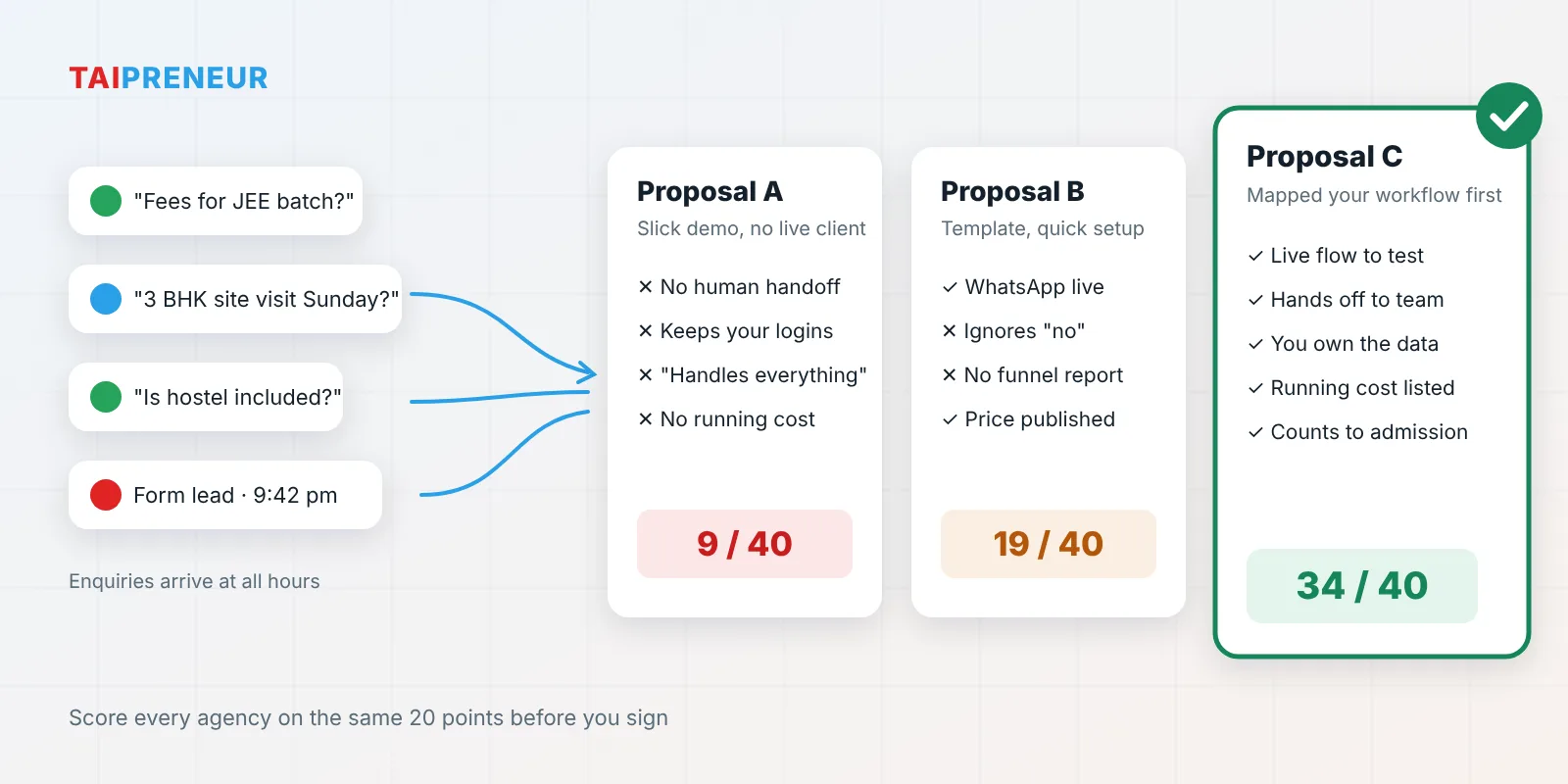
Choose the AI automation agency that maps your enquiry-to-sale workflow before quoting, shows you a live client flow you can test, hands uncertain chats to your staff, lets you own every account and the data, lists the monthly running cost, and reports enquiries through to paid customers. Score each agency on the 20 points below; sign only above 28/40.
- Most failed automations don't fail on the AI. They fail on follow-ups that never stop, handoffs that reach nobody and nobody counting results.
- Use one scorecard for every agency: 20 points in five groups. It turns a sales call into a comparison.
- Run a 30-minute test on a flow they've built for another client before you sign: message it at night, say "not interested", ask something it can't know.
- Budget for two bills: the build (one-time) and running costs (WhatsApp messages, AI usage, CRM, support). WhatsApp charges changed again on 1 Oct 2026.
- You are responsible for your customers' data under India's DPDP law. Get the data terms in writing.
Every owner I talk to this year has had the same pitch: "we'll put AI on your WhatsApp and you'll never miss a lead again." Some of those projects work. Many end as a bot that replies fast for two weeks, then quietly annoys customers while nobody checks it.
I build WhatsApp and lead-follow-up automations for coaching institutes, colleges and real-estate firms in India. I've also broken things in production, and those mistakes taught me what to ask an agency. This guide is the checklist I'd use if I were hiring one. It works whether you choose me, a big agency or a freelancer.
What should an AI automation agency actually build for you?
Not "a chatbot". For an Indian business that runs on enquiries, a useful automation covers the path from first message to paid customer. That path has five stages, and a good agency asks about all five before quoting.
A JEE coaching institute gets 40 enquiries a day from Instagram ads. A weak proposal adds a bot that answers fee questions. A strong one also books the counselling call, reminds the parent the day before, stops messaging the parent who said "already joined elsewhere", and tells Meta which leads became admissions, so the next ads find more students like them.
Stage 5 is the one most agencies skip, and it's often where the money is. When a college group I worked with started sending admitted-student data back to Google and Meta, the ads began optimising for students who join, not just people who fill forms.
Why do so many AI automation projects disappoint?
Gartner expects over 40% of agentic AI projects to be cancelled by the end of 2027, mostly because of cost, unclear value and weak risk controls. It also warns about "agent washing": old chatbots and scripts rebranded as AI agents. My own reasons, from a live WhatsApp sales assistant I worked on for a Bangalore real-estate firm, are more ordinary:
- Follow-ups got the WhatsApp number restricted. A second template went to hundreds of people who had never replied. Enough of them blocked or reported it that Meta restricted the account for 30 days. Non-repliers should get an email or one human call, not more WhatsApp.
- "Not interested" didn't stop everything. One channel stopped, another kept going. A single "no" must end the sequence everywhere, and that has to be tested before launch.
- The handoff reached nobody. The bot told buyers "an advisor will call you". The staff alerts were switched off, so nobody called. A handoff that reaches nobody is worse than no handoff.
- One word changed the bill and the delivery. A button reading "Book a Site Visit" got the template classed as marketing and some messages were dropped. "Site visit" was classed as utility and delivered.
- Nobody counted the stages, so nobody knew where leads leaked: enquiry → reply → qualified → booked → attended.
None of these is an AI problem. They're design and operations problems, and you can spot them on an agency call if you ask the right questions.
The 20-point agency scorecard
Score each point 0 (no), 1 (partly or "we can") or 2 (yes, and they showed you). Twenty points, maximum 40. Tick the boxes below while you're on the call; the total updates as you go.
Total: 0 / 40 · walk away
How do you test an agency in 30 minutes before you sign?
Ask for a WhatsApp number or website where their automation runs for a real client. Then do this, on your own phone:
Why the timing matters: a well-known study of US companies found that firms that contacted a web lead within an hour were nearly seven times more likely to qualify it than firms that waited longer (Oldroyd, McElheran and Elkington, Harvard Business Review, 2011). Many Indian enquiries arrive after office hours, which is when a slow reply costs the most.
Send one genuine enquiry and a couple of normal questions. Don't spam a real business or waste their staff's time. You're testing the system, not the people.
What does AI automation cost in India in 2026?
There are two bills. Most proposals only show the first one.
| What | Typical range | What drives it |
|---|---|---|
| One flow (e.g. instant WhatsApp reply on one channel) | Tens of thousands of rupees, one-time | Channels, how many facts it must know, handoff |
| Full enquiry desk (capture, reply, follow-up, booking, report) | Higher one-time build; ours is ₹35,000 | Number of sources, CRM, ad feedback, branches |
| Run and improve | Monthly; ours is ₹15,000/month, minimum 3 months | Weekly chat review, fact updates, reporting |
| WhatsApp messages | Paid to Meta per message, plus your provider's fee | Message type (marketing, utility, service), volume |
| AI usage | Usually small per chat; grows with volume | Model used, length of each chat |
| Tools | CRM, automation tool, WhatsApp provider plan | Seats and plan tier |
For comparison, one Bengaluru agency publishes a starting price of about ₹38,000 for a single working flow (Haldar AI). A quote of a few thousand rupees usually means an unconfigured template. A quote in lakhs for one flow deserves a line-by-line explanation.
The WhatsApp bill keeps changing
Meta has charged per delivered message since 1 July 2025, priced by message type and the customer's country. From 1 October 2026, utility messages inside the 24-hour customer service window are charged again, and service replies are free only for the first 1,000 per phone number each month. Marketing rates for India also rose on 1 January 2026 (Meta, Pricing on the WhatsApp Business Platform). If a proposal still says "replies are free", it was written before these changes. Ask for a monthly estimate at your volume.
Who owns your customers' data?
You do, and you're responsible for it. Under India's Digital Personal Data Protection Act, the business that decides why data is collected is the "data fiduciary"; the agency processing it for you is a "data processor". The DPDP Rules were notified in November 2025, with most duties phasing in over 18 months (YourStory, Khaitan & Co). Ask the agency for four things in writing:
- Which customer data the automation stores, and where (country and service).
- Who on their side can see chats, and how access is removed.
- How a customer's "delete my data" request is handled.
- That all data is returned and deleted when the contract ends.
This is a practical checklist, not legal advice. For a large database, have a lawyer read the contract.
Can you use ChatGPT on WhatsApp for your business?
Not as a general-purpose assistant. WhatsApp's business terms bar general-purpose AI chatbots from the WhatsApp Business API from 15 January 2026. Bots that serve a business's own customers, like answering fee or site-visit questions, are still allowed (TechCrunch). So the right build is narrow on purpose: it answers from your signed-off facts and hands everything else to a person. An agency pitching "ChatGPT on your WhatsApp that answers anything" is selling the wrong thing.
Red flags: when to walk away
- Guaranteed results before seeing your data ("3× admissions in 30 days").
- "The bot handles everything", with no handoff plan.
- Your WhatsApp number or ad account registered in their name.
- No answer to "what will this cost me each month?"
- A retainer before any build, or a 12-month lock-in for a first project.
- Only demos on their own website, nothing running for a client.
- They can't say what the bot is forbidden to say (discounts, refunds, possession dates, admission guarantees).
Agency, freelancer or do it yourself?
| Option | Fits when | Watch out for |
|---|---|---|
| DIY with your WhatsApp provider's built-in flows | Under ~20 enquiries a day, simple questions, someone on your team likes tools | Nobody owns follow-up rules or the report |
| Freelancer | One clear flow, a tight budget, you can manage the project | Single point of failure; get the handover in writing |
| Specialist agency | Several channels, a CRM, ad feedback and weekly improvement | Lock-in and running costs; use the scorecard |
Local or remote matters less than you'd think. What matters is that they reply in your working hours and understand how Indian customers behave: WhatsApp first, voice notes, parents deciding for students, family visits on Sundays.
Frequently asked questions
How long does an AI automation project take?
One flow, like instant WhatsApp replies on one channel, can go live in about a week. A full enquiry desk with follow-up, booking, CRM and ad feedback usually takes two to three weeks, plus a few weeks of weekly fixes once real customers use it.
Do I need to change my CRM or tools?
Usually not. A good agency connects what you already use: your forms, Google Sheets, Zoho or another CRM, and your WhatsApp provider. Be careful if the first step is moving everything to their platform.
Will an AI bot get my WhatsApp number banned?
The bot itself won't. Spammy behaviour will: repeated templates to people who never replied, no opt-out, and messages after someone says no. Ask how the agency watches your quality rating and stops sequences.
What should I measure in the first month?
Five numbers every week: enquiries, median first-reply time, qualified leads, visits or counselling calls booked, and paid customers. Measure them for a week before the build so you have a baseline.
Is a monthly retainer worth it?
For the first project, a fixed-scope build with a short run-and-improve period is safer than an open retainer. Once the flow works and you see the weekly report, a monthly fee for review and improvements makes sense.
Should I choose an agency in Bangalore or anywhere in India?
Anywhere works for most automation, as long as they reply in your hours and know your industry. Choose local if you want in-person workshops with your counsellors or sales team.
Which AI model should the agency use?
It depends on the task, and that's the right answer to hear. Many agencies mix models by cost, speed and accuracy. What matters more is that the bot answers only from your facts and hands off when unsure.
What to do today
Before your next agency call, run the 30-minute test on your own enquiry flow tonight. Message your business at 9 pm from a personal number and see what happens. Whatever breaks is the brief for the agency, and you'll know within one call whether they can fix it.
Taipreneur builds enquiry desks for coaching institutes, colleges and real-estate firms: capture, instant reply, follow-up that obeys "no", booking and a weekly report. See AI automation, or how it works for education and real estate. If you're also working on being found in ChatGPT, read how builders and brokers get recommended by AI.