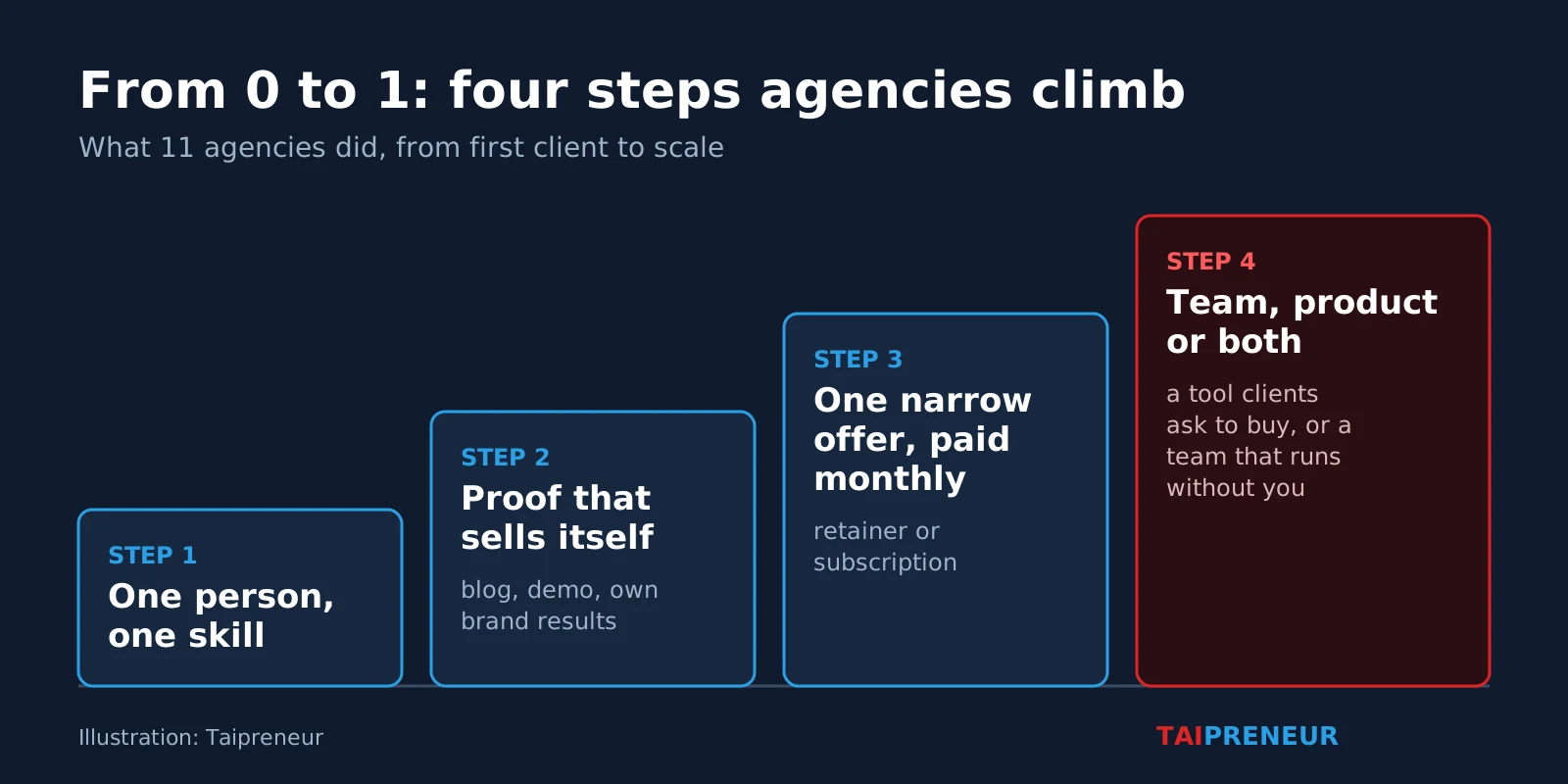
Most great agencies started with one or two people, no clients and very little money. They got their first clients from proof they had already made (a blog, their own brand, a demo), not from pitching. They grew by narrowing to one offer billed every month, and many of the biggest outcomes came from turning a service into a product. On services: development brings the biggest revenue but the thinnest margin, design and small studios keep the most profit, SEO and paid ads bring recurring revenue, and AI integration is where demand is growing fastest.
- Proof before pitch. Vayner, Moz, 37signals and Designjoy all won clients with work people could see before they asked.
- One narrow offer beats a menu. Specialist agencies grew about 13% in 2025 against a 7.5% average, per Promethean Research data.
- Small is more profitable; big grows faster. Studios under 10 people kept ~19% net margin; agencies of 50+ kept ~8%.
- Revenue and profit live in different services. Development agencies bill the most and keep the least.
- The big exits came from products. Basecamp, Moz and Tiny all began as client-service shops.
This is a field guide, not a list of famous names. For each agency we looked for four things: how it started, where the first clients came from, the moment it nearly broke, and what it turned into. Then we put the services side by side to see which ones actually pay.
Every number below links to its source. Figures were checked on 23 November 2026. Where a number is self-reported by the founder or comes from a secondary summary, we say so.
What did 11 agencies look like on day one?
Look at the "started with" column. Nobody started with a team of 20, a big budget or a list of clients.
| Agency | Started | Started with | First clients came from | Where it got to |
|---|---|---|---|---|
| Ogilvy (USA) | 1948 | $6,000 of his own, plus backing from two London agencies2. No clients, staff of two1 | British brands such as Wedgwood38 | ~17,500 people (2022)3 |
| Infosys (India) | 1981 | 7 engineers, ₹10,000 from Sudha Murty4 | Hard-won overseas clients; "Brand India" was weak5 | A $16bn+ company4 |
| 37signals (USA) | 1999 | 3 co-founders, a web design shop7 | Design clients | Basecamp out-earned the agency6 |
| Webchutney (India) | 1999 | 2 co-founders, digital-only, when brands spent little online39 | Brands moving to the web | Dentsu bought 80% in 2013, team of ~20019 |
| Moz (USA) | ~2002 | Mother and son, a small web design shop8 | A blog about learning SEO8 | SEO software company9 |
| MetaLab (Canada) | 2006 | One person, cold emails10 | Startup CEOs found on TechCrunch10 | Funded Tiny, a listed holding company11 |
| VaynerMedia (USA) | 2009 | Two brothers12 | Results from their own family wine business12 | $131M revenue (2018)14 |
| Social Beat (India) | 2012 | Two brothers, bootstrapped23 | Social media for Indian brands40 | Reported acquired by Cheil SWA24 |
| Directive (USA) | 2014 | Two co-founders, Fiverr gigs17 | Small search jobs, then B2B software firms | $150K+ average yearly contract (self-reported)18 |
| Schbang (India) | 2015 | 3 co-founders, a decade of digital experience21 | Brands wanting creative + media + tech in one place21 | 1,070 people by 202222 |
| Designjoy (USA) | 2017 | One designer, a side project15 | One-page site, later Twitter | $4,995/month per client, still solo16 |
Solo, duo or team: which start works?
All three work. They fail in different ways, so pick the one whose weakness you can live with.
Solo: fast, cheap, capped by your hours
MetaLab was one person cold-emailing startup founders10. Andrew Wilkinson presented it as a bigger agency and booked about $15,000 of work in his first month25. Designjoy is still one person. Brett Williams said he made over $50,000 a month alone, working 50 to 60 hours a week, with about $2,000 a year in costs15.
Solo works when the work is packaged so tightly that one person can deliver it. Designjoy takes unlimited requests but works on one at a time16. That one rule is what makes "unlimited" survivable.
Duo: one sells, one delivers
The pattern repeats: VaynerMedia (brothers Gary and AJ), Moz (Rand Fishkin and his mother Gillian), Social Beat (brothers Vikas and Suneil Chawla), Webchutney (Sidharth Rao and Sudesh Samaria), Directive (Garrett Mehrguth and Tanner Shaffer). Usually one partner is the public face and the other runs operations. AJ Vaynerchuk, for example, covered finance, operations and client service in the early days13.
Team: slower start, longer runway
Infosys began with seven engineers and ₹10,0004. Sudha Murty later said getting the very first customer was extremely hard5. A team shares the pain of a slow start; a solo founder has to absorb it alone.
Where did the first clients actually come from?
Not from pitching strangers with a deck. In almost every case, the founder had already made something a buyer could see.
- Their own brand's results. Gary Vaynerchuk built his family's Wine Library online, then sold the same playbook to other brands12.
- A blog. Rand Fishkin started blogging what he learned about SEO. Clients began asking for SEO instead of web design8.
- A public point of view. 37signals launched with a manifesto on how the web should be designed. The New York Times wrote about it26.
- Social posts. Brett Williams has said Twitter was Designjoy's main lead source27.
- Cheap, small jobs. Directive's founder bid on Fiverr gigs and lived on about $12 a day while he learned search17.
Before you send 100 cold emails, make one thing a buyer can check in two minutes: a before/after for a real business, a short teardown of their funnel, or a working demo. Cold outreach that links to proof is a different message from cold outreach that asks for a call.
What nearly killed them?
Every story has a moment that could have ended it. They are useful because they are specific.
- Debt from bad delivery. Moz's founders were around $500,000 in personal debt, partly from hiring contractors who did poor work928.
- One big deal falling through. Webchutney hit serious money trouble in 2007 when a deal with MakeMyTrip didn't happen20.
- Founder dependence. Digiday reported that clients often came to VaynerMedia for Gary himself, which is hard to scale29.
The lesson is boring and true: one client should not be able to sink you, and delivery quality is a cash-flow issue, not just a reputation one.
How did they grow from first client to real company?
1. They narrowed the offer
Directive sells only annual contracts, with a minimum of about $10,000 a month, to B2B software companies18. Designjoy sells one plan16. Promethean Research's 2026 data, as summarised by Agiled, shows specialist agencies grew about 13% in 2025, almost double the 7.5% average31.
2. They moved to monthly billing
A project pays once. A retainer or subscription pays every month. Designjoy's whole model is a monthly subscription16, and 78% of SEO providers in Ahrefs' survey bill a monthly retainer32.
3. They grew with the channel, not against it
Webchutney started in 1999, when brands spent almost nothing on digital39. VaynerMedia bet on social media in 200912. Social Beat began as a social media company, then added ads and SEO as clients needed them23, and went from ₹7 crore revenue in 2019 to a ₹40 crore run rate in FY2223.
4. They tied fees to client results
Gary Vaynerchuk told Business Insider he actively seeks pay linked to how much the client sells14. Directive's site now calls it a "revenue partner" rather than an agency30.
5. Some turned the service into a product
This is where the biggest outcomes came from.
- 37signals built Basecamp to manage its own client projects. It reached $5,000 a month within weeks. A year or so later it earned more than web design, so they stopped doing web design6.
- Moz launched its first subscription tool at $39 a month while still consulting, then raised $1.1M in 20079.
- MetaLab's profits funded Tiny's first acquisitions11.
- Social Beat spun out Influencer.in and D2Scale33.
Notice the order. None of them started as a product company. The client work showed them which problem was worth a product.
Is a small agency more profitable than a big one?
Usually, yes. But it grows more slowly. That trade-off is the most useful thing a founder can know before deciding to hire.
Across agencies, Promethean Research puts the average net margin at about 13% in 2025, even though the average project margin was about 35%34. The 22 points in between are salaries for people who aren't billing, tools, rent and unpaid pitches.
Which agency services earn the most, and which are in demand?
"Most revenue", "most profit" and "most demand" are three different questions. Here is each service against all three.
| Service | How it's usually billed | What the data says | Revenue shape |
|---|---|---|---|
| Website and app development | Fixed project, then support | Development agencies average about $9.11M revenue but only about 11% net margin34 | Big, one-off, lumpy |
| Design and branding | Project or subscription | Design agencies average about $1.77M revenue with the highest margin, about 18%34. Designjoy charges $4,995 a month16 | Smaller, high profit |
| SEO (and now GEO / AEO) | Monthly retainer (78% of providers)32 | Average about $2,917/month. In India, 76% charge $1,000 a month or less32 | Recurring, slow to prove |
| Paid ads (Google, Meta) | % of ad spend or flat fee | About 70% of agencies on a %-of-spend model charge 10–20%35 | Recurring, grows with client's budget |
| AI automation, chatbots, AI integration | Build fee, then monthly upkeep | Fastest-growing demand: AI integration +178%, AI chatbot development +71% on Upwork36. No reliable public price benchmark yet | Project now, recurring if you run it |
| Strategy and consulting | Retainer or day rate | SEO consultants average $3,250/month vs $1,349 for freelancers32 | Highest per hour, tied to the founder |
The non-obvious part
- Revenue and profit sit in different places. Development brings the biggest bills and the thinnest margin34. If you need cash flow, build. If you need profit, design or advise.
- Ads income depends on the client's budget. With a %-of-spend fee, your revenue rises when they spend more and falls the month they cut back35.
- SEO prices are not global. India-based SEOs charge far less than US ones in Ahrefs' survey32. An Indian agency serving overseas clients earns the gap; one serving only local clients competes on price.
- AI demand is "AI applied to a job", not "AI in general". Upwork's research lead described the growth as AI used within a context37. "AI chatbot for admission enquiries" sells; "AI services" doesn't.
- The best package is a bundle around one outcome. Build the automation (project cash), run it monthly (recurring), and feed it with ads or search (demand). Each service covers the others' weakness.
Frequently asked questions
How long does it take an agency to go from 0 to 1?
It varies a lot. Basecamp beat 37signals' design revenue about a year after launch. Designjoy ran as a side project for years. Moz took years to get out of debt. Plan for slow, and count months to the first repeat client, not the first client.
Should I start an agency alone or with a co-founder?
Alone is fastest and keeps the most margin, but your hours cap it. Many agencies in this list started as duos: one sells, one delivers. Choose the weakness you can live with.
Which agency service is most profitable?
In Promethean Research's 2026 data, design agencies had the highest net margin (about 18%) and development agencies the lowest (about 11%). Studios under 10 people averaged about 19%.
Which agency service is most in demand in 2026?
AI applied to a specific job. On Upwork, AI integration demand rose 178% and AI chatbot development 71% in 2025. Established skills like full-stack development stayed strong.
Retainer or project pricing: which is better?
Projects bring cash; retainers bring predictability. Most SEO providers (78% in Ahrefs' survey) bill retainers. A common path is a paid build first, then a monthly fee to run it.
What should you do today?
Write your offer in one line, the way Designjoy does: who it is for, the one result, the monthly price, and how a client can stop. If it doesn't fit in one line, it is still a menu.
If your one result is more enquiries and more booked appointments, that is what Taipreneur works on. You can also read how to choose an AI automation agency in India.
- Hachette, David Ogilvy author page
- Encyclopedia.com, Ogilvy Group history
- Wikipedia, Ogilvy (agency)
- Business Today, From Rs 10,000 to over $16 bn: Infosys
- The Week, Infosys @ 40
- Jason Fried, Basecamp turns 20
- Wikipedia, 37signals
- MasterNewMedia, The full story of SEOmoz told by Rand Fishkin
- SEOmoz, 2011 company deck (Rand Fishkin)
- Tiny, About
- Tiny, Metalab
- Gary Vaynerchuk, Biography
- Capitalism.com, AJ Vaynerchuk interview
- Business Insider, VaynerMedia revenue (2019)
- Indie Hackers, Brett Williams AMA (self-reported)
- Designjoy, pricing page (read 23 Nov 2026)
- Mixergy, Garrett Mehrguth interview
- Latka, Directive founder interview, Oct 2021 (self-reported)
- Campaign India, Dentsu acquires majority stake in Webchutney (2013)
- Business Today, Who is Sidharth Rao
- exchange4media, Schbang founders interview (2019)
- BestMediaInfo, Schbang (2022)
- Business India, Social Beat: Tiger from the South
- Storyboard18, Cheil SWA acquires Social Beat
- Bench, Andrew Wilkinson profile
- Signal v. Noise, How 37signals built buzz out of the gate
- Onepage Research, Designjoy timeline
- Inc., 15 facts about Rand Fishkin
- Digiday, How Gary Vee became the ad industry's lightning rod
- Directive, Our story
- Agiled, Agency growth statistics (summary of Promethean Research 2026)
- Ahrefs, SEO pricing survey (439 SEOs)
- MediaNews4U, Social Beat at 12 years
- BSS Commerce, Agency profit margin benchmarks (summary of Promethean Research 2026)
- WordStream, State of the agency report
- Upwork, In-Demand Skills 2026 press release
- Fast Company, AI-related skills demand up 109%
- Britannica, David Ogilvy
- Business Standard, Webchutney and Dentsu (2014)
- YourStory, Social Beat's early bet on digital (2021)